AI for Design Research: Keeping Sources and Claims Accurate
A process for using AI in design research without losing accuracy: frame the questions, gather primary sources, ask for citations, verify claims, and keep a source log.
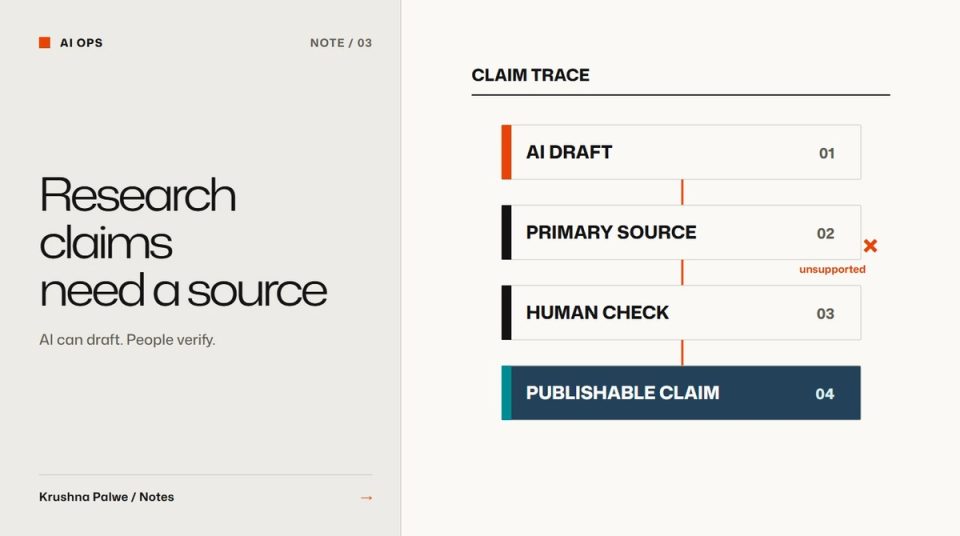
AI is very good at the slow parts of design research: reading long pages, summarising patterns, comparing many competitors, drafting an audit structure. It is also very good at sounding certain about things that are not true. In design work that matters, because research feeds positioning, copy and claims that end up on a public website. AI design research is useful only when the process keeps every claim tied to a source a person has checked.
I use Claude, Claude Code and Codex for research, scaffolding and review. At Datamotive, AI tools compressed research, scaffolding and token-consistency checks, while hierarchy, typography, language and what shipped stayed human decisions. This is the research part of that workflow.
Frame the questions before asking anything
Vague prompts produce vague research. Write the questions first, the same way you would brief a person:
- What do competitors in this category claim, and how do they prove it?
- Which visual conventions are shared across the category?
- What do buyers need to know that most sites do not say?
- What has changed in the category in the last year?
Each question should have a clear use. If you cannot say what decision an answer will inform, the question is probably not needed. The same discipline applies to briefs, covered in AI-assisted design workflow with human review gates.
Gather primary sources yourself
The most reliable research starts with sources you choose: competitor websites, product documentation, published standards, the client's own data, interviews. Give these to the AI rather than asking it to recall them. A model summarising a page you provided is far more trustworthy than a model remembering what a company says.
For visual research, capture the material directly. The competitive visual audit process depends on consistent, dated screenshots, and AI can help organise and code them, but the captures themselves should be real.
Ask for citations and quotes
When AI summarises, ask it to attach the source for every claim: the page, and the exact sentence it relied on. That changes the output from an essay into a list of checkable statements. It also makes gaps obvious. If a claim has no source, it is an inference or an invention, and should be treated that way.
Ask the model to separate three kinds of statement:
- Observed: directly stated in a source.
- Inferred: a reasonable conclusion from several sources.
- Unknown: not answerable from the material provided.
Most hallucination problems come from inferences presented as observations.
Verify every claim that will be published
Anything that will appear in a client deliverable, on a website or in a deck gets checked against its source by a person. Prioritise:
- Numbers: percentages, market sizes, performance figures, prices.
- Comparisons: "faster than", "the only", "first to".
- Quotes and attributions.
- Technical claims a specialist reader will test.
A strict version of the rule works well for portfolios: outcome and savings numbers stay off the page unless they are sourced, while counts of your own deliverables, such as packaging designs or listings, can stay because you can verify them. The same rule protected Datamotive's website, where claims had to survive a cloud architect's reading.
Watch for confident filler
AI-written research often contains statements that sound like findings but say nothing: "users value simplicity", "trust is crucial in enterprise software". They are not wrong, they are just not research. Strip them out. A good research summary is specific enough that someone could disagree with it.
Keep a dated source log
Keep a simple log beside the research:
- The question.
- Each source, with its URL or file and the date captured.
- The claim drawn from it.
- Whether it was verified, and by whom.
Websites change. Six months later, the log is the only way to know what was true when a decision was made. It also lets someone else check the work without repeating it.
Protect confidential material
Do not paste confidential client data into tools without permission and appropriate settings. Some client work cannot leave the client's environment at all. When in doubt, summarise or anonymise first, and agree the rules with the client before the project starts.
Use AI for structure, not conclusions
The best use of AI in research is often structural: turning forty pages of notes into a comparison table, suggesting categories for coding, finding which sources disagree, drafting interview questions. Conclusions, especially positioning conclusions, stay with the designer and the client, because they depend on judgement about what the brand should become, not only on what the material says.
A research accuracy checklist
- Were the questions written before prompting?
- Were primary sources gathered and provided directly?
- Does every claim have a cited source and quote?
- Are observed, inferred and unknown statements separated?
- Has a person verified every number and comparison that will be published?
- Is there a dated source log?
- Was confidential material handled with permission?
After research comes output review, covered in the AI design output QA checklist. You can see how research shaped positioning and language in the Datamotive case study, and how I describe my AI workflow on the about page.